


Camino de Santiago: Órbigo Bridge - Astorga

I'm a hooked on the Camino de Santiago. I could not tell you very well why.
Today I want to show you a stage that I walked in 2014. It has not been the most beautiful stage of the Camino, but it was the most overwhelming and disturbing.

Between the bridge of Órbigo and Astorga the stage runs through the Páramo leonés, through a kilometric desert almost flat. El Páramo leones is a region that is located in the southern half of the province of León. It is just south of the Cantabrian mountain range and is between the fertile valleys and confluences of the Esla and Órbigo rivers.
It stands out for being one of the flattest areas of the Iberian Peninsula. It was generated by fluvial deposits millions of years ago and has been preserved almost without erosion until our days. In this area, there were millions of years ago large rivers that dragged a huge amount of materials that, over time, gave rise to this area of great sedimentation in the basin of the river Duero.

The region of Páramo Leonés is geologically a plain formed by sediments between two rivers. It is the largest in León, and one of the largest in the Iberian Peninsula. It is 50 km long and 30 km wide. It is practically flat, without relieving or pending

At present the rivers have been having their channels, but they have left intact long plains and small hills. As there is no lack of water, they carry out intensive agriculture.
In recent years, there has been an intensive cultivation of corn, even to vary the climate of this area becoming more humid in summer.

The popular paramesa architecture is composed of basic materials that are found in the area: mud, adobe, wood, straw and boulders.
The adobe, bricks of uncooked mud, to which straw is added as a method of cohesion.
The Camino de Santiago is full of history and traditions, after all, it has more than 1000 years of history and all this has been reflected in its journey. In the Bridge of Órbigo a great medieval tournament happened whose fame has reached our days. I intend to make a * post * only intended for this meeting of gentlemen.

The Órbigo bridge is of Roman origin and was rebuilt in the 13th century.


For me it was a challenge to walk alone alone through this infinite and dry plain. It was a challenge for me. On many occasions I was wondering if I was not crazy and why I do this. But I was happy. I did it, a bit like personal improvement and also because I love feeling integrated with nature.

In a few occasions one can simply enjoy the charm of nature. We can hear the sounds of the countryside, the birds, the breeze, our footsteps ...


Few decide to do this stage. It must be pretty horrible to do it in summer. It would only be possible early in the morning to finish it before 9-10.

You have to go well equipped because there are not many places to get water or supplies.


In the background a group of trees. Upon entering, I observed that the floor of this grove was covered with a blanket of white fluff, as if it were snow ..
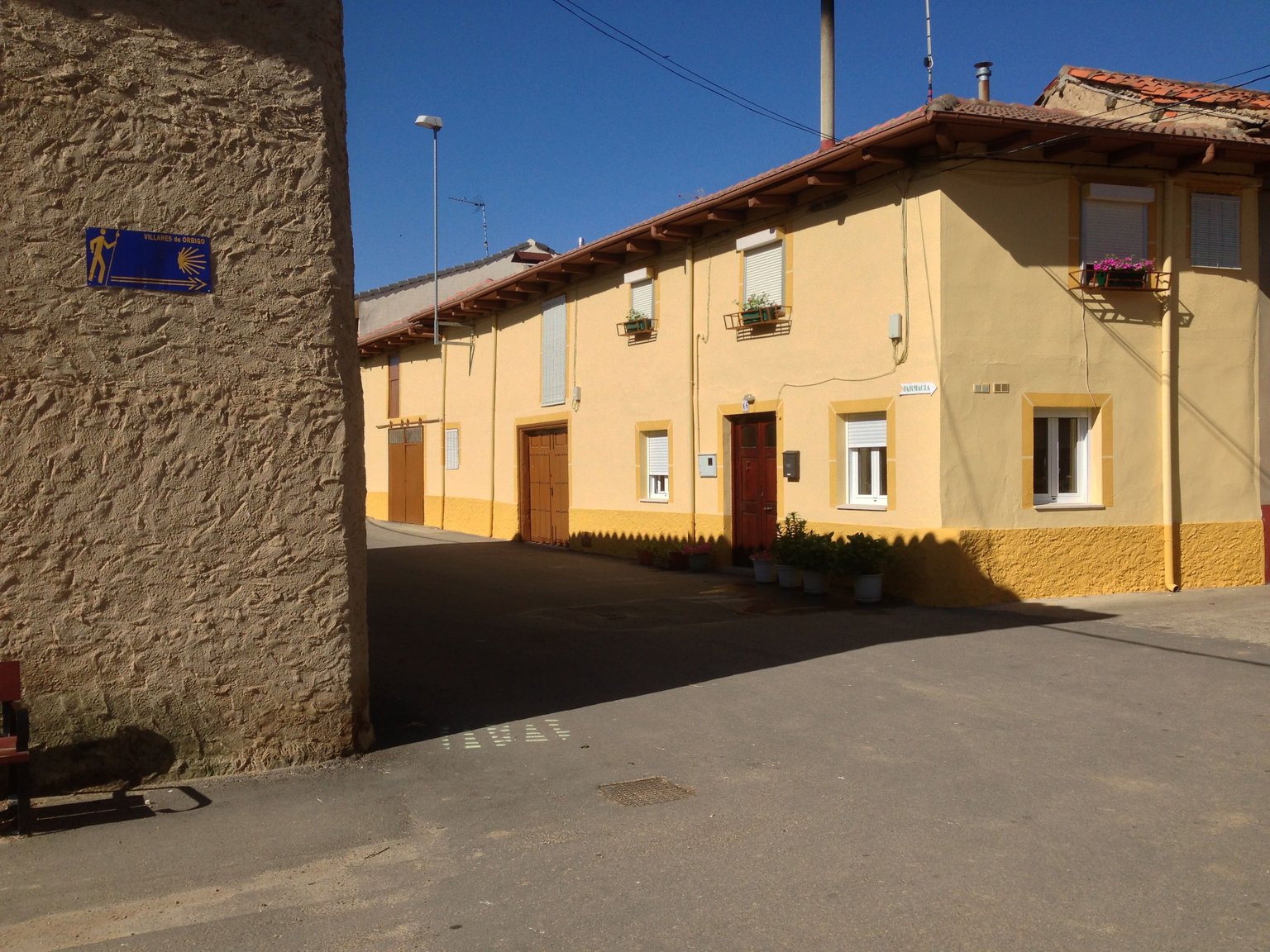
A small town appeared where you can rest and drink a beer without alcohol.

IMG_1328.JPGenero-2012.jpg


In the meadows, the leaves of the crops swayed in the form of waves that traveled long distances. The gentle breeze moves these leaves all together in one or the other direction, giving the sensation of a swell. I had never had occasion to observe this before. In a lake the ripples of the water provoked by the breeze if we are accustomed to see them, but not in plains of kilometric crops.

In the credential, it is convenient to go sealing to be able to show the kilometers that you have done when you finally arrive in Santiago. I also like to remember the places where I stopped and why some stamps are very beautiful.


Like a mirage, when the plain started to shine too much forcing me to close my eyes a lot, I saw a point at the end of the line.
As I was closing in, I did not know what it could be.

The sun was strong and there was no possible shade to shelter. In this situation, I could only lower my head and walk forward if I did not want to stay there forever. Probably the mobiles would not have there coverage to ask for help. There was no way to ask a taxi driver to get there on impassable roads. So all that remained was to continue forward without stopping.
As I got closer, that dark spot on the top of the hill grew and, to my surprise, it seemed to be an umbrella.
If it was a shadow!
Lucky!
That place was located at a point where if you can not rest, you may have a very bad time, because the sun was already burning very hard.
In fact, there was a small stall made up of sticks and canvas, creating a space of shade forming a kind of * jaima * and some pilgrims were sitting there in silence.

I was received by a guy wearing only swimsuits and indicating with a smile that you would sit me down and rest. He told me that I could use and take what I wanted that was free. He encouraged me to eat and drink whatever I wanted. There were fruits, soft drinks, water and shade in the wagon.
An oasis!

I took off my backpack and hydrated myself, glancing sideways at a couple of young pilgrims who were there too, tired, and silent. How many kilometers would they have walked out of civilization, in this desert?
I realized that what I was seeing was memorable. I was wondering what the hell am I doing here? But also what the hell is this guy doing here?

In the decorated and flirtatious green trolley, he had written a phrase: "Essence is presence."

Many times I have asked myself what I would like to say with this. For this hermit that phrase was the reason why he was there in balls, with nothing, attending to the pilgrim. It was his reason for being and it made him happy.
Maybe he meant that the essential is the present? Do you live life and enjoy the present? I dont know. Or, perhaps, he claimed that thanks to being present at this point he could help us in such a tough area.

He was a freak. A blessed one. A pirado that had realized that in that point a place of aid to the pilgrim was important. I asked him how long he was there and he told me that he lived there all year.
I found it a horrible place to live, where it can get very cold and very hot. At night it can be below or very close to zero degrees and in the winter all this plain would be covered by snow. While in summer that is a desert.
Behind the * jaima * there is an adobe building, which probably in the past would be for cattle or pigs and there you can see a young woman coming and going. Of course, as the bullfighter said, "there are people pa tó" I thought. What need did he have to live there?
Why these two people have chosen to leave everything and help the pilgrim?

The fact is that he looked happy. He chatted with everyone who stopped and showed them a smile.
I wondered about the banality of life and the desire for possessions. Meanwhile, there are these hermits who live badly, but happy, with what they put on and renouncing everything, but being very useful in a deserted and uninhabited point of a kilometric desert plain.

In the solitude of the road, having a pilgrim in sight makes you a lot of company.


Storks make their big nests in electric turrets.

The yellow arrows and the shells indicate the direction of the road to Santiago.

Entering Astorga. My goal was to eat a good cooked maragato and it was already being announced.


Before entering Astorga, you have to cross the motorway through some horrible level steps. The return to reality.


I ate a well-deserved Cocido Maragato.


As I told you the other day in a * post * that I wrote especially about the cocido Maragato.
The cooked maragato is eaten upside down. That is, the meats are served first. Then the chickpeas and vegetables and finally the broth. The last the broth that, although you think you will not be able to handle it, it goes very well. For dessert, the classic is custard.


If you liked this * post * you can vote or resteem it and keep it in your blog.
I await your comments!


Comments
Post a Comment